South Africa’s Attack Fires Immediately — But the Defensive Questions Haven’t Gone Anywhere
Eighty points, twelve tries, and a stadium in Gqeberha that emptied having watched one of the highest-scoring opening halves South Africa has produced in years — on paper, this was a thrashing. South Africa’s 80–31 dismantling of the Barbarians at Nelson Mandela Bay Stadium on 20 June 2026 will be filed, fairly, as a statement of attacking intent from Rassie Erasmus’s re-shuffled squad. But wins this lopsided rarely tell only one story, and buried inside the scoreline is the same issue that has followed the Springboks all year. They can be scored against, too.
This was never going to be judged as a normal Test. The Barbarians fixture carried no cap, no world ranking points, and none of the operational weight of the matches to come. What it did carry was purpose. As the opening game of South Africa’s international season, it was Erasmus’s first live opportunity to look at combinations and fringe players before the real business of facing the old foe, England, begins. Everything about how the match was set up — the size of the squad rotation, the willingness to blood uncapped talent — points to a coaching staff using the occasion as an audition, not a target for a hiding.
An Avalanche Built on Continuity, Not Caution
The number that frames everything else is seventeen — the combined try count across both sides, in a match that, by both teams’ own instinct, was played at a tempo that discouraged conservative rugby. South Africa and the Barbarians both prioritised keeping the ball alive over kicking for territory, and that shared approach explains why the scoreboard moved so fast in both directions. It also explains South Africa’s method of scoring. The Springboks repeatedly exploited broken defensive structures through quick handling, support running and high-tempo attacking play rather than relying on prolonged phase-by-phase pressure.
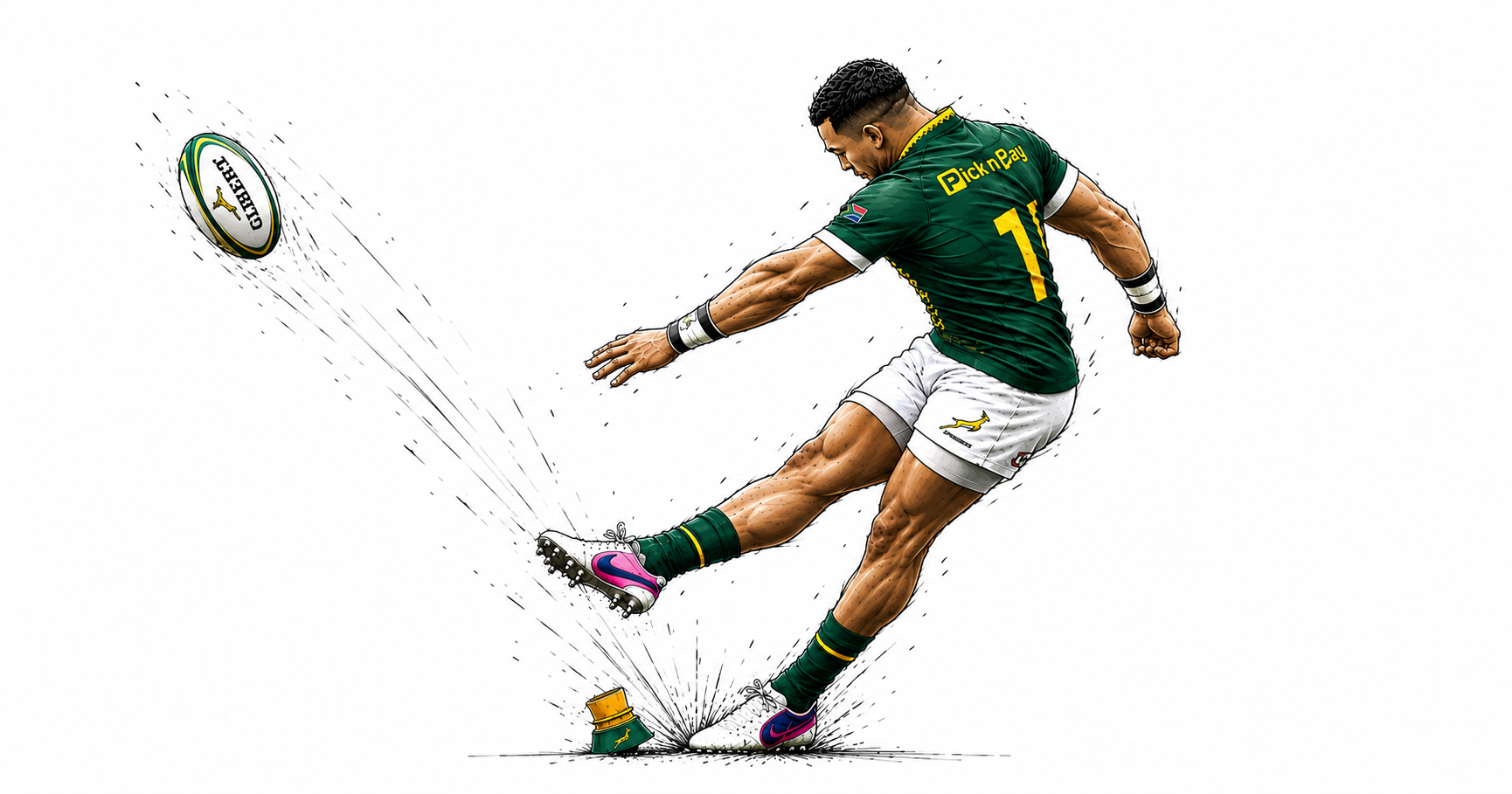
Cheslin Kolbe was central to translating that attacking intent into points on the board. Handed the primary goal-kicking duties for much of the match, he converted try after try with an accuracy that meant South Africa’s dominance in the tries column was never diluted at the tee — a detail easy to overlook next to twelve tries, but one that mattered to a margin this large. It’s little surprise he was one of South Africa’s standout performers. Edwill van der Merwe was another major beneficiary of that broken-field rugby, running in a hat-trick on his way to being officially awarded Man of the Match — a statement performance as he made his case for a bigger role.
The Half That Should Concern Erasmus More Than It Pleases Him
Here is where the story complicates. South Africa led 40–26 at the break — a scoreline that means the opening 40 minutes alone produced 66 points, one of the highest-scoring first halves South Africa has been involved in for several seasons. That is not simply a function of a rampant Springbok attack; it’s also a function of South Africa conceding 26 points before half-time, as the Barbarians exploited defensive disconnects and loose spacing whenever they got hold of the ball. Yellow cards for both sides during the second quarter compounded the disruption, and for a period, a team many expected to cruise instead found itself in a genuine arm-wrestle.
The response, when it came, was total. South Africa regained control of territory and the set piece in the second half, building pressure that Barbarians increasingly struggled to withstand, before finishing with four unanswered tries in the final quarter to turn a contest into a demolition. That closing burst coincided with fresh legs off the bench, whose intensity drove the late surge.
The shape of the match, then, tells a more useful story than the final score does on its own. South Africa’s attack barely needed a first half to find its rhythm, but its defence needed a second half to find its discipline. Both things can be true of the same 80-point win.
Own the Breakdown
The result told only part of the story. With Test rugby against England approaching, Erasmus used a deliberately mixed squad — established internationals alongside players with little or no caps — and the Barbarians’ traditionally expansive style gave those fringe players something closer to genuine pressure than a training run would. That several of them contributed positively, in a match that swung meaningfully before South Africa pulled clear, is the kind of evidence a coaching staff actually needs, rather than results manufactured in a mismatch.
South Africa’s win extended their historical dominance over the Barbarians, and by full time, few neutral observers would argue the better side didn’t win comfortably. But the value of this fixture was never really about extending that record. It was about establishing, three weeks out from Tests that count, which of South Africa’s fringe players can be trusted with more — and being reminded, in the same 80 minutes, that the defensive lapses which have periodically troubled this Springbok side did not stay in the changing room just because the opposition wore Barbarians black-and-white.
South Africa
Starting: 1 Ox Nché, 2 Andre‑Hugo Venter, 3 Carlu Sadie, 4 Riley Norton, 5 Franco Mostert, 6 Siya Kolisi (c), 7 Pieter‑Steph du Toit, 8 Jasper Wiese, 9 Grant Williams, 10 Quan Horn, 11 Edwill van der Merwe, 12 Andre Esterhuizen, 13 Jesse Kriel, 14 Cheslin Kolbe, 15 Aphelele Fassi
Impact: 16 JJ Kotze, 17 Ntuthuko Mchunu, 18 Zachary Porthen, 19 Ben‑Jason Dixon, 20 Paul de Villiers, 21 Evan Roos, 22 Faf de Klerk, 23 Vusi Moyo
Barbarians
Starting: 1 Mayco Vivas, 2 Elliot Dee, 3 D’Arcy Rae, 4 Franco Molina, 5 Izack Rodda, 6 Guido Petti, 7 Lachlan Boshier, 8 Miracle Fai’ilagi, 9 TJ Perenara (c), 10 Tomás Albornoz, 11 Duhan van der Merwe, 12 Alex Nankivell, 13 Virimi Vakatawa, 14 Andrew Kellaway, 15 Warrick Gelant
Impact: 16 Leonel Oviedo, 17 Oli Kebble, 18 Pedro Delgado, 19 Sintu Manjezi, 20 Liam McConnell, 21 Santiago Arata, 22 Harry Plummer, 23 Tuidraki Samusamuvodre
Venue: Nelson Mandela Bay Stadium, Gqeberha
Kick‑off: 15:00 SAST
Attendance: 26,398
Match Officials
Referee: Morné Ferreira (SARU)
Assistant Referees: Griffin Colby, Hanru van Rooyen
TMO: Marius van der Westhuizen
FPRO: Marius Jonker