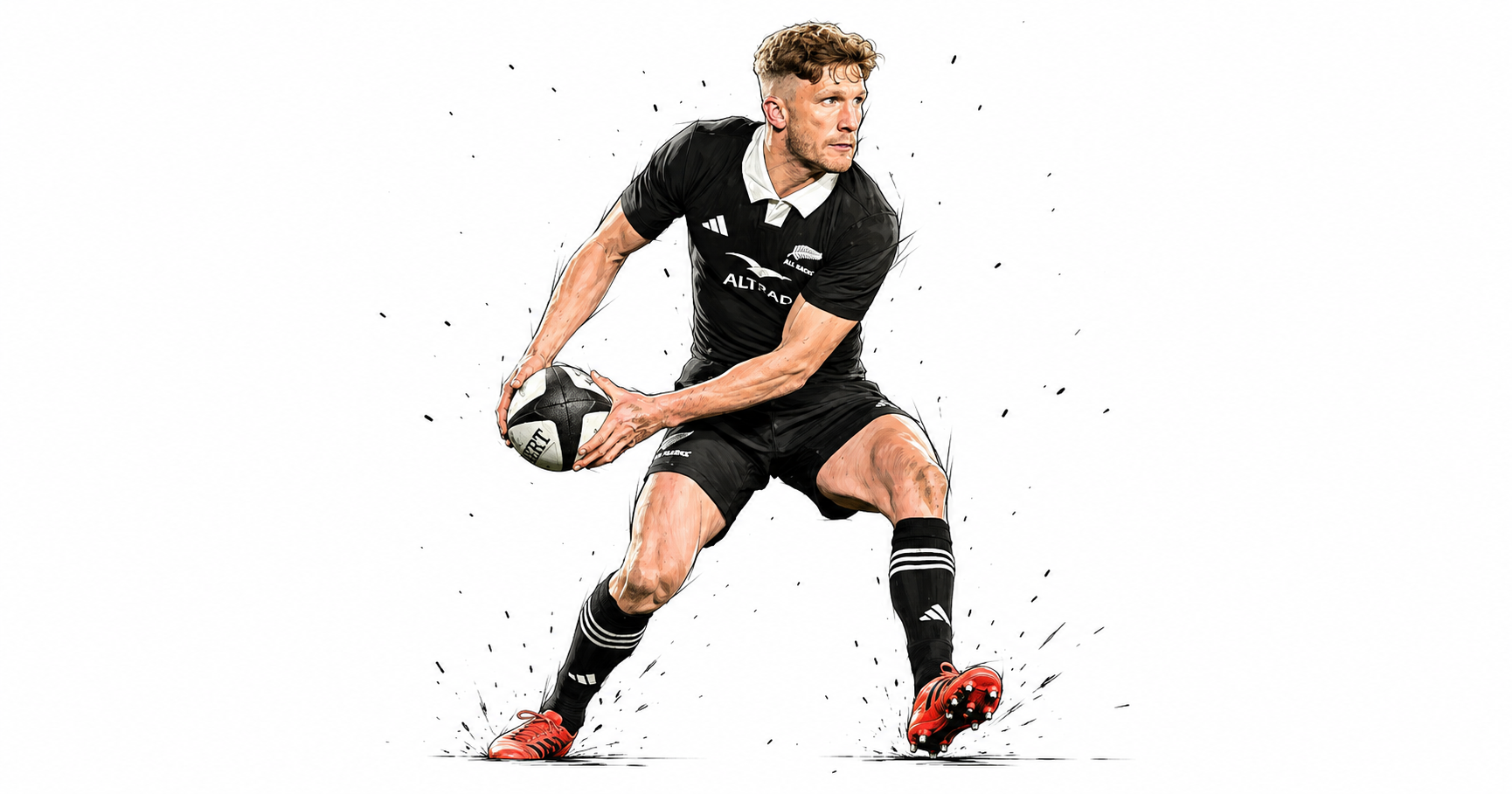
New Zealand 40-21 Ireland: Eden Park’s fortress holds as clinical first half buries brave Irish response
Ireland arrived at Eden Park with a specific piece of history in their sights. No visiting side had won a men’s Test on this ground since France managed it in 1994. They leave having discovered exactly why that record has stood for three decades. New Zealand’s 40-21 victory extended the All Blacks’ unbeaten run at their Auckland fortress to 53 consecutive Tests, and while the final scoreline suggests a comfortable evening’s work, the truth is more specific than that. This match was decided in a 24-minute window either side of the interval, during which New Zealand scored four tries, one of them with fourteen men on the pitch, and Ireland’s night effectively ended before it had properly begun.
New Zealand Strike a Man Down
The story of the opening half is not simply that New Zealand were good. It is that they stayed good at the exact moment discipline threatened to undo them.
Patrick Tuipulotu opened the scoring after fifteen minutes, and Ardie Savea doubled the lead seven minutes later. Ireland’s route back into the contest opened at 28 minutes when Luke Jacobson was shown a yellow card for dangerous head contact on Josh van der Flier, reducing New Zealand to fourteen players. A bunker review followed, with no upgrade to red, a decision that in hindsight mattered enormously to how the match unfolded. Ireland eventually made the numerical advantage count through Jack Conan at 33 minutes, cutting the gap to 14–7. The foothold lasted only two minutes. Will Jordan finished a brilliant counter-attack at 35 minutes, and Asafo Aumua added another try just before half-time to send New Zealand into the break 28–7 ahead. Whatever momentum Conan’s try had generated was gone by the time the players reached the tunnel.
Why the response never quite closed the gap
Ireland’s first-half struggles were not primarily about New Zealand doing anything spectacular in open play — they were about handling. Garry Ringrose’s two early errors set a tone that repeated itself throughout the first forty minutes, with Ireland’s turnovers regularly handing New Zealand attacking ball in exactly the areas they wanted it. Andy Farrell later acknowledged Ireland’s uncharacteristic errors, lack of first-half accuracy and inability to establish attacking rhythm as key reasons his side spent the match chasing the game.
That is what makes Ireland’s second-half performance worth taking seriously rather than dismissing as a mere consolation. Joe McCarthy scored early after the restart, and Hugo Keenan finished a third Irish try at 63 minutes, giving Ireland two second-half tries to match New Zealand’s own two in the same period. Farrell was right to note the improved accuracy after the break. But Ireland had left themselves too much to do. New Zealand’s clean execution and Ireland’s handling errors had created a 21-point deficit that accuracy alone could not overcome. Anton Lienert-Brown’s try in the closing minutes, New Zealand’s sixth of the night, secured the bonus point and put a final, emphatic number on the scoreline.
Territory as the quiet engine of the result
Beneath the try count sat a more structural explanation for the result. New Zealand controlled field position throughout the match, regularly forcing Ireland to start possessions deep inside their own half. Ruben Love and Damian McKenzie provided an effective tactical kicking game, while the pressure from New Zealand’s defensive line made it difficult for Ireland’s first receivers to find clean attacking platforms. McKenzie’s influence extended beyond territory and into the attack, earning him the Player of the Match award. Ireland were able to build longer attacking sequences in patches of the second half, but they never matched New Zealand’s territorial dominance from the opening forty minutes — precisely the period in which the match was effectively settled.
The underlying statistics reinforce that pattern. New Zealand had 59% of possession to Ireland’s 41% and gained 558 metres from their carries, compared with Ireland’s 414 metres. The All Blacks also produced 10 clean breaks to Ireland’s 5, beat 35 defenders compared with 15, and forced Ireland into conceding 18 turnovers while surrendering only 9 themselves. Those numbers support what was visible on the field. New Zealand’s tactical kicking and line speed consistently forced Ireland to play from deep, allowing sustained territorial pressure to become scoreboard pressure.
Individual impact within the framework
Individual contributions mattered here mostly in how well they served that broader pattern rather than as isolated moments of brilliance. Ardie Savea’s try while his side played with fourteen men was as much about composure as finishing, and he was repeatedly identified in post-match coverage as one of New Zealand’s most influential figures on the night. Ruben Love’s five successful conversions from six tries, paired with his territorial kicking, made him central to both the scoreboard and the tactical picture. Asafo Aumua’s try immediately before half-time — the score that turned a workable Irish deficit into a daunting one — encapsulated the bench-to-starter forward impact that ran through New Zealand’s performance.
For Ireland, Jack Conan’s consistent carrying and Hugo Keenan’s aerial threat under pressure were among the few individual positives from a difficult night, though neither could offset the collective handling problems that shaped the contest’s opening act. Sam Prendergast converted all three Irish tries and managed Ireland’s territory competently after the break, doing what he could with the position his team had put itself in.
Own the Breakdown
It is worth returning to where this match began; with Ireland hoping to become the first visiting side to win at Eden Park since 1994. That framing matters not as decoration but as context for how the result will be read. New Zealand’s unbeaten run at the ground now stands at 53 Tests, and this victory (their third from three in the opening block of the Nations Championship) was built in the manner that has sustained that record for so long. The relentless first-half execution, territorial control, and the discipline to keep scoring even when reduced to fourteen men was the difference on that fateful night at Eden Park. Ireland’s second-half response was real, and Farrell’s team will point to genuine improvement in accuracy after the interval. But by the time that response arrived, New Zealand had already done the damage that mattered most.
New Zealand
Starting: 1 Ethan de Groot, 2 Codie Taylor, 3 Tyrel Lomax, 4 Josh Lord, 5 Patrick Tuipulotu, 6 Tupou Vaa’i, 7 Luke Jacobson, 8 Ardie Savea (c), 9 Cam Roigard, 10 Ruben Love, 11 Josh Moorby, 12 Jordie Barrett, 13 Quinn Tupaea, 14 Will Jordan, 15 Damian McKenzie
Impact: 16 Asafo Aumua, 17 Xavier Numia, 18 Fletcher Newell, 19 Anton Segner, 20 Peter Lakai, 21 Cortez Ratima, 22 Anton Lienert‑Brown, 23 Caleb Clarke
Ireland
Starting: 1 Tom O’Toole, 2 Dan Sheehan (c), 3 Tadhg Furlong, 4 Joe McCarthy, 5 James Ryan, 6 Tadhg Beirne, 7 Josh van der Flier, 8 Jack Conan, 9 Jamison Gibson‑Park, 10 Sam Prendergast, 11 Jimmy O’Brien, 12 Stuart McCloskey, 13 Garry Ringrose, 14 Rob Baloucoune, 15 Hugo Keenan
Impact: 16 Rónan Kelleher, 17 Jeremy Loughman, 18 Thomas Clarkson, 19 Nick Timoney, 20 Sean Jansen, 21 Craig Casey, 22 Ciarán Frawley, 23 Bundee Aki
Venue: Eden Park, Auckland
Kick‑off: 19:10 local (NZST)
Attendance: 48,500 (sell‑out)
Match Officials
Referee: Nic Berry (Australia)
Assistant Referees: Luc Ramos (France), Damon Murphy (Australia)
TMO: Ben Whitehouse (Wales) FPRO: Andrew Jackson (England)